Showing posts with label sir john gielgud. Show all posts

Wednesday, June 20, 2012

Alice in Wonderland (1966)


Four our last stop in Wonderland we look at possibly the most unique adaptation in our journey. Produced and directed for the BBC by former Beyond the Fringe writer and humorist Jonathan Miller. It's unique in the sense that Miller made a conscious decision NOT to have the actors dressed as animals but instead have them simply appear in Victorian dress.

Miller justified his approach as an attempt to return to what he perceived as the essence of the story: "Once you take the animal heads off, you begin to see what it's all about. A small child, surrounded by hurrying, worried people, thinking 'Is that what being grown up is like?'
Those who are too young or unfamiliar with British Satire and the counter culture movement of the 1960's might find this take on the tale confusing and boring.

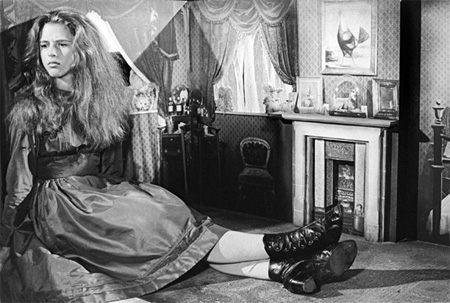
Matter of fact, Anne-Marie Mallik, the young actress playing Alice comes off as very disinterested and bored at her whole "Wonderland" experience. Then again, Alice seemed very much that way in Sir John Tenniel's artwork, didn't she?


Apparently,  Miller had envisaged an Alice "with no stage experience, not very pretty but curiously plain, sallow and a bit priggish".
Well, spot on!!

But to be fair to Ms. Mallick, this was her first and only acting job.

The movie itself is awash in the feel of the 1960's culture as far as it's off-beat and somewhat experiemental interpretation of Alice. Music is composed and performed by Ravi Shankar who was beginning to catch the public eye due to his association with George Harrison and the Beatles. Though not to detract for his own talents as a great musician.

It is almost entirely filmed at Netley Hospital, which was a 19th Century Building which incidentally got demolished shortly after this film was made.

This was also a time of the Satire Boom in the 1960's. There is quite a bit of that visually in many of the scenes of the movies. Especially in the scenes with the Queen of Hearts as well as the courtroom scenes.

Comedy in England became more cerebral and pointed. As was as socially and politically charged as the way people began to look at the world changed. Satire became a way for many writers and comedians to express themselves. Jonathan Miller, Peter Cook, Alan Bennet and Dudley Moore would influence many of these young would be satirists. Most notably, Eric Idle who would later gain fame as a cast member of Monty Python's Flying Circus.
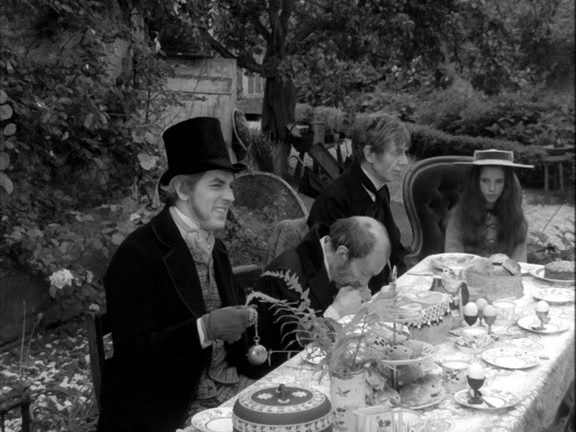


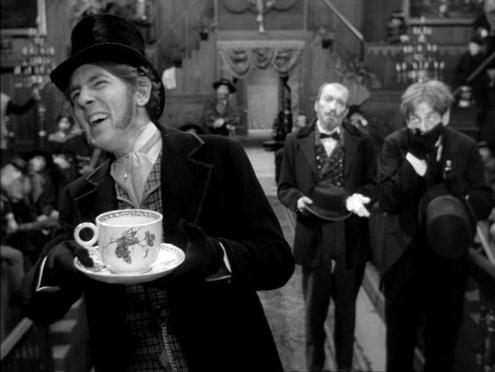
Much like the later 1972 version of Alice, this film is a veritable "who's who" of British actors with Jonathan Miller's Fringe cohorts Peter Cook and Alan Bennett as the Mad Hatter and Mouse respectively. Also featuring Wilfrid Brambell as the White Rabbit, Leo McKern as the Duchess,  Michael Redgraves as the Caterpillar, Michael Gough as the White Rabbit, Sir John Gielgud as the Mock Turtle and Peter Sellers as the King of Hearts.

As mentioned in a previous blog, Sellers would later play the part of the March Hare in the 1972 version of Alice.

There is also an uncredited appearance of future Monty Python star Eric Idle in the courtroom scene. This film is actually Mr. Idle's first television appearance.

All the portrayals of the characters are different from what we have come to expect. Most notably Peter Cook's take on the Mad Hatter, Michael Gough's March Hare and Sir John Gielgud's playing the Mock Turtle like a retired thespian rather than the baleful creature we know from the story.

For me, I enjoyed the take on the story. But as I mentioned earlier. If you don't have any interest in either British satire or comedy. Or really know or have much interest in 1960's culture, you may find this version to be a tad on the tedious and boring side.

But I would give any of these films a try. Even the ones I said weren't particularly my favorites I would try them anyways. Even if I don't particularly care for them, doesn't necessarily mean you won't care for them.

Never judge anything bad just by what someone else says. Judge it for yourself and draw your own conclusions. The only way you're ever going to know if you like something or not is to actually watch, listen or read something.

You might find yourself pleasantly surprised with what you discover.

Friday, January 27, 2012

Murder By Decree (1979)

Most people (myself included in the past) think between the times of Basil Rathbone and Jeremy Brett there were no really strong Sherlock Holmes movies or television outings. And that most of the films between those times lazily follow the formula created in the Rathbone/Bruce outings of the stiff and pragmatic Holmes with Meerschaum Pipe clenched firmly between his teeth and the inept and bumbling old duffer Watson who can't get out of his own way to save his life.

However, this is not entirely true. Yes, some of the films of that time did fall into some of those trappings. But that doesn't mean they are bad films. Some of them are quite good.

Which brings me to 1979's Murder By Decree. Which I must confess I do not enjoy as much as the previous Holmes vs. the Ripper offering A Study in Terror. But it is still a great film all the same.

And far more historically accurate with it's facts about the Jack the Ripper case than the previous film.

This time Sherlock Holmes comes in the form of Christopher Plummer. This is not his first outing having previously starred in a one off television movie based on the story The Silver Blaze.

Much like Robert Stephen's take on Holmes, Christopher Plummer gives us an entirely different approach to the character that was established by Basil Rathbone. We see a more emotional Holmes than we have seen in past films. There is more empathy and humanity than we've seen in the character. And it works really well in the context of this film given the gruesome nature of the historical case.

This film is also bloodier and the violence a bit more gristly than the previous Holmes/Ripper offering. Which, given the previous film had been produced in 1965, there was a great deal of things that they simply could not get away with at that time.

But given how violent films have gotten since 1979, the scenes in this film are actually tame by today's standards. I find many of the scenes a lot easier to get through compared to the film adaptation of From Hell.

The ironic thing about that is the fact even though Murder By Decree is using a character from classic literature at the center, it's still actually more historically accurate than the film version of From Hell.

There was a supposed psychic in the case, but it was a man by the name of Robert Lees and not Inspector Abberline as suggested in From Hell.

Although, I did find it slightly disappointing that both version of the Holmes/Ripper movies did omit Inspector Abberline from the narrative. I think it would have been interesting to have both men working side by side. Or at least acknowledging one another in passing.

This brings me to the cast of this movie.

Alongside Christopher Plummer's Holmes is veteren actor James Mason as the ever-faithful Doctor John Watson. Despite being a touch too old for the role, I really enjoyed James Mason's take on Watson.

Again, most people erroniously think that every Watson actor who has played him between Nigel Bruce and David Burke (from the Jeremy Brett series) all play him as the stumbling old fuddy duddy who just gets underfoot when Holmes is trying to solve a case.

I can think of several exceptions to that rule. James Mason is one of those. He plays Watson as a very level-headed man of medicine who is invaluable when Holmes for both his medical knowledge and scientific training.

My next blog post might be on some of the great film and television Watson.

We also have two actors from the previous Holmes/Ripper movie in this film. One of which is Frank Finlay once again marvelously playing the "rat-faced" Inspector Lestrade. I still believe him to be the very best on-screen Lestrade to date. The other is Anthony Quayle who had a role in the previous Ripper movie and returns in this one. This time as Sir Charles Warren.

The cast is rounded off by Donald Sutherland as the alleged psychic Robert Lees and theatre great Sir John Gielgud as the Prime Minister.

It should be mentioned this is not Sir John's first brush with Sherlock Holmes having played the part for radio alongside Ralph Richardson as Watson. The series is worth a listen. Especially for the fact the radio adaptation for The Final Problem stars Orson Welles as Professor Moriarty.

The result is an exceptional film. Not to mention a fairly historically accurate account of the Jack the Ripper murders. As much as I would love to tell you who they deem Springheeled Jack as, I think it would be best if you saw it for yourself.

Much like many of the Sherlock Holmes films I have mentioned, this one deserves more of an audience. I highly recommend you become part of that audience.